
“Join the Transformational Timeline Theory (TTT) course, where you’ll master timing and life phases to enhance your tarot practice. Before checkout, add a personalized TTT consultation to apply the theory directly to your life, or include the TTT Workbook for practical timing exercises. Select your add-ons below.
Advance Tarot Lessons & Transformational Timeline Theory (TTT) Course
Soy bilingüe y ofrezco mis servicios en ambos idiomas.
-
-
Advance Tarot-Lesson 1
Introduce your lesson with an optional, short summary. You can edit this excerpt in lesson settings.
Introduce your lesson with an optional, short summary. You can edit this excerpt in lesson settings.
-
Lesson 2
Introduce your lesson with an optional, short summary. You can edit this excerpt in lesson settings.
Introduce your lesson with an optional, short summary. You can edit this excerpt in lesson settings.
-
-
-
Lesson 1
Introduce your lesson with an optional, short summary. You can edit this excerpt in lesson settings.
Introduce your lesson with an optional, short summary. You can edit this excerpt in lesson settings.
-
Lesson 2
Introduce your lesson with an optional, short summary. You can edit this excerpt in lesson settings.
Introduce your lesson with an optional, short summary. You can edit this excerpt in lesson settings.
-
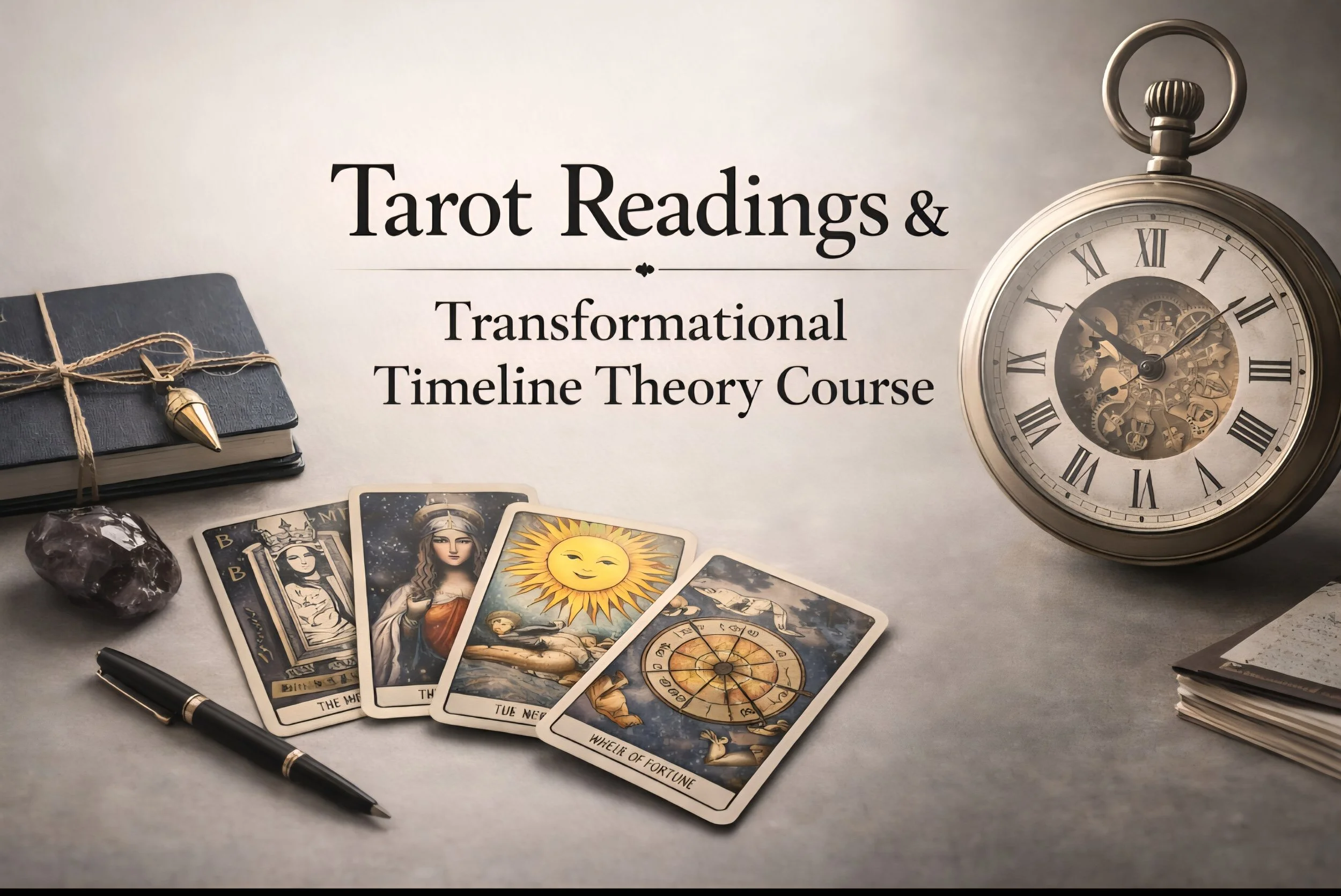
Introducing Transformational Timeline Theory (TTT) Course
When I began working with tarot, I saw readings captured isolated moments, but not the full picture of movement. Through my journey and writing Transformational Timeline Theory (TTT), I identified four key phases: current, momentum, wave, and threshold. This course shows you how to track that momentum, applying TTT to give your tarot practice the full timeline—helping you guide yourself and others with clarity. Learn the core TTT framework—currents, waves, and thresholds—so you can recognize timing patterns in any life situation.
Apply TTT to your tarot readings, transforming them into precise tools for understanding timing and life transitions.
Gain practical skills to map personal or client timelines, improving the clarity of your guidance.
Benefit by offering deeper, narrative-based tarot insights, making your readings or coaching more impactful and timing-aware.
FAQs
-
These products are structured reflective tools. While they may be used in intuitive or personal contexts, they are primarily designed for analysis, self-reflection, and timeline awareness rather than prediction or belief-based systems.
-
These tools are designed for individuals interested in self-reflection, life pattern analysis, personal development, and structured insight into phases of change.
-
Can I use TTT without tarot experience?
Yes. Transformational Timeline Theory (TTT) is a standalone framework and does not require any tarot knowledge to use. It is designed as a structured tool for analyzing phases of change across different situations, relationships, life events, or ongoing patterns.TTT can be applied with or without tarot because its primary function is timeline placement — identifying Current, Momentum, Wave, and Threshold phases within a given structure. Tarot may be used as an optional reflective layer, but it is not necessary for the system to function.
The framework is intentionally universal. It can be used for personal development, decision tracking, long-term planning, behavioral patterns, or even structured observation of external situations. Some users apply it to life events, projects, routines, or other evolving circumstances.
In practical terms, TTT is less about belief and more about organization. It provides a clear way to track change over time and anticipate transitions rather than react to them.
For users who enjoy staying aware, proactive, and structured, TTT functions as a practical and engaging tool that helps bring order to change instead of leaving it abstract or unpredictable.
-
The TTT Map, Questionnaire, and Textbook serve different roles within the Transformational Timeline Theory (TTT) system.
The TTT Map is a visual placement tool designed to help users locate where they are within a phase of change, such as Current, Momentum, Wave, or Threshold. It provides a structural overview rather than interpretation.
The Questionnaire is a guided assessment tool that helps identify patterns, duration, and contextual factors influencing a situation. It is meant to support accurate placement on the timeline through structured reflection.
The Textbook is the extended version of the system. It provides deeper explanations, theoretical context, case-style examples, and advanced methods for interpreting timeline phases. While the textbook expands understanding, it is not required to use the Map or Questionnaire.
In short, the Map shows placement, the Questionnaire supports analysis, and the Textbook provides deeper study of the full TTT framework.